幸福来敲门
4,220-year-old rock art in SW China’s Yunnan reveals early cultural links with Southeast Asia_我的网站

一 |
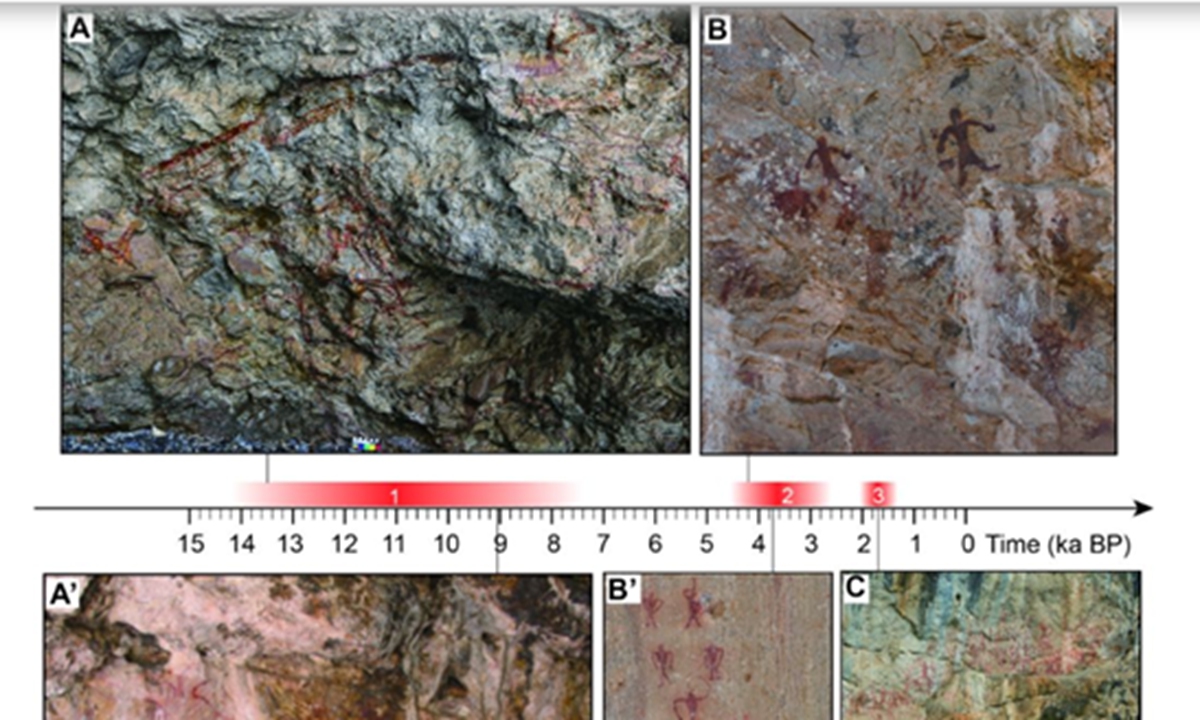
Timeline of the major painted rock art groups in Southwest China: A-A′: Jinsha River rock art; B-B′: Mangguan-Cangyuan rock art; C-C′: Zuojiang rock art Photos: Xinhua
Chinese researchers have obtained the first absolute dates for rock paintings at the Mangguan rock art site in Southwest China's Yunnan Province, pushing the known history of rock art created by prehistoric settled communities in the region back to about 4,220 years ago. The paintings also suggest cultural interactions more than 4,000 years ago between Southwest China and civilizations along the Yellow and Yangtze rivers, as well as possible exchanges with neighboring parts of Southeast Asia, including present-day Myanmar, Thailand and Vietnam, a member of the research team told the Global Times.
The Yunnan Provincial Institute of Cultural Relics and Archaeology, in collaboration with Nanjing Normal University and other institutions, have recently made a significant archaeological breakthrough. Through systematic surveys and uranium-thorium (U-Th) dating at the Mangguan site in Gengma county, the research team obtained the first absolute dates for the site's rock paintings, tracing rock art created by prehistoric settled communities back to around 4,220 years ago.
The findings were recently published in the international journal
Journal of Archaeological Science: Reports.
The Mangguan rock paintings represent one of the best-preserved prehistoric rock art sites in Yunnan. The research team presented high precision U Th dating of carbonate accretions that stratigraphically overlie the painted motifs at the Mangguan site, according to the paper published in the journal.
The dating results show that carbonate deposits overlying a human figure yielded a corrected age of 4,240 ± 19 years before present, confirming that ancient people living in the region had already produced mature figurative art at least 4,220 years ago, Wu Yun, first author of the paper and an associate researcher at the Yunnan Provincial Institute of Cultural Relics and Archaeology, was cited by the Xinhua News Agency report as saying.
Dating results from 11 samples taken from different motifs clustered between about 3,907 and 3,056 years ago. By comparison, the Cangyuan cliff paintings had previously been dated to roughly 3,800 to 2,700 years ago. The Mangguan paintings are therefore significantly older, filling an important chronological gap in the region's artistic record before the Cangyuan phase.
Shao Qingfeng, corresponding author of the paper and a professor at the School of Geography at Nanjing Normal University, told the Global Times that previous estimates dated the Mangguan rock paintings to a little over 3,000 years ago based mainly on imagery and comparisons with similar regional sites. Using microsamples of secondary carbonate deposits overlying the paintings, researchers have now obtained a precise minimum age of about 4,220 years before present without damaging the rock art.
The findings and the establishment of this chronological framework not only strengthen the archaeological foundation for studying rock art in Southwest China, but also provide a direct reference for rock art sites across Southeast Asia that have yet to undergo systematic dating, Shao said.
The findings may also challenge long-held perceptions of Southwest China around 4,200 years ago - roughly the era of the Xia Dynasty (c.2070 BC-C.1600 BC) - and help fill a key gap in understanding the pluralistic yet integrated development of Chinese civilization.
Shao said that while academic research has traditionally focused on the Yellow River and Yangtze River basins as cradles of early Chinese civilization, sites such as Mangguan and Cangyuan show that stable and culturally active communities also thrived in mountainous Southwest China. The newly established rock-art chronology brings an artistic dimension to the broader narrative of China's enduring cultural development.
Moreover, stylistic similarities suggest that Southwest China maintained exchanges with the Yellow River and Yangtze River regions and with early societies in Southeast Asia, providing material evidence of cross-regional interaction more than 4,000 years ago.
。 8 月 25 日消息,科技媒体 AppleInsider 昨日(8 月 24 日)发布博文,报道称在 macOS 27 Golden Gate 更新中,苹果公司已将终端命令 hdiutil 标记为弃用,预估会在未来版本中移除。注:hdiutil 是苹果 macOS 终端中的磁盘镜像工具,自早期 Mac OS X 时代起就用于处理磁盘镜像,可执行挂载、创建、调整和弹出镜像文件等操作。它长期用于系统维护、备份和磁盘修复,也常用它解决系统拒绝弹出“正在使用中的磁盘镜像”等问题。开发者 Jeff Johnson 最先发现,苹果已在 macOS Golden Gate 中为 hdiutil 添加弃用提示。

二 | 终端输入 man hdiutil 后,macOS 27.0 的说明会建议用户改用 diskutil image。

三 | 苹果表示,diskutil image 支持挂载、创建、调整大小、查看信息和修改密码等操作,而且该命令支持 ASIF(Apple Sparse Image Format,苹果稀疏镜像格式)。苹果尚未说明何时彻底移除 hdiutil。diskutil image 当前尚未覆盖 hdiutil 的全部功能,且两者行为存在差异。

四 | Johnson 表示,备份流程调用 hdiutil 时,如果文件归 root 用户所有,系统会弹出身份验证提示;diskutil image 则不会提示,而是直接返回通用错误。

五 | 该媒体推测苹果弃用 hdiutil 关联安全问题,苹果在 2025 年 10 月 15 日发布的安全更新中修复了 macOS Sonoma 的一个漏洞。该漏洞可能导致执行 hdiutil 命令时意外运行任意代码,苹果称修复方式是移除存在风险的代码。
Current article:http://wxaau.ruwentaqintiaozhupapaigai.shop/news/20260826_6386.html
Published on:01:15:07